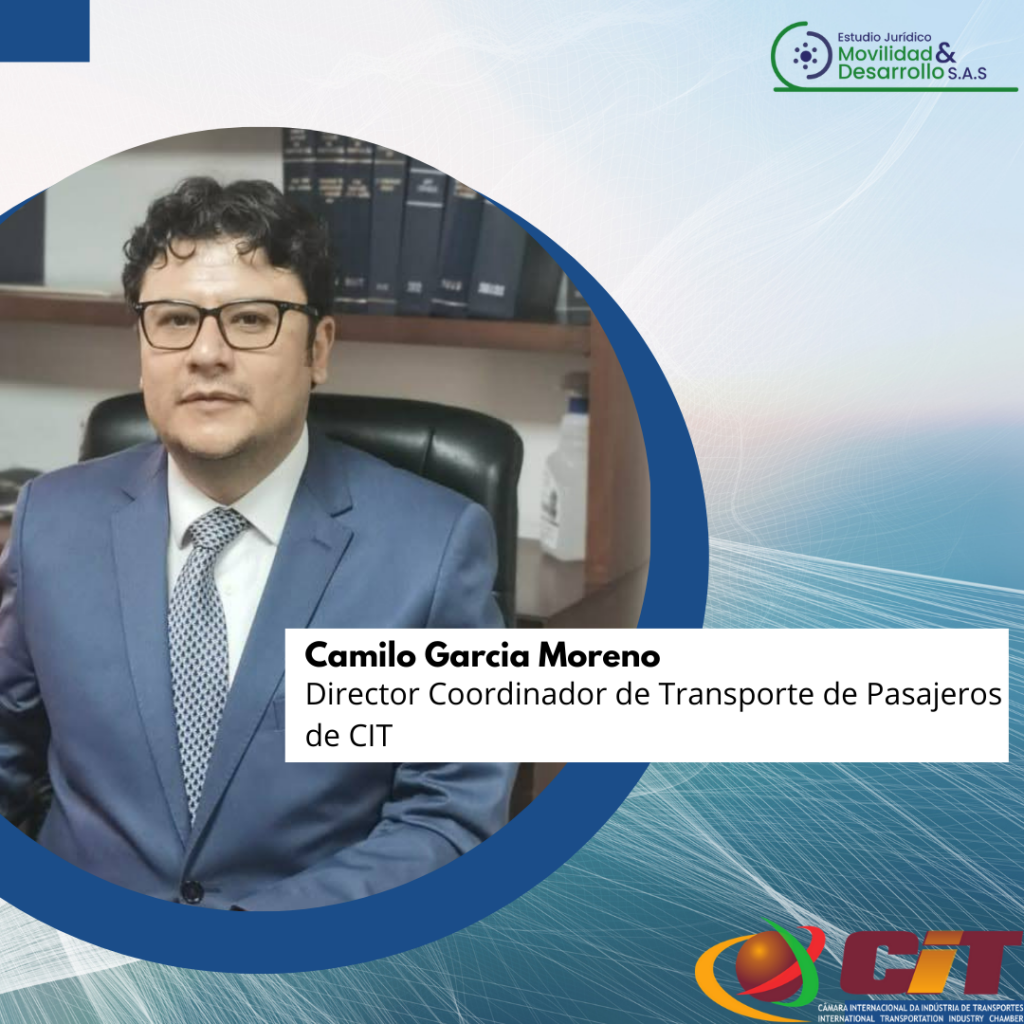
By Fredy Camilo García Moreno. Coordinating Director of Passenger Transportation of CIT.
From the International Chamber of Transport Industry we have promoted reflection and debate on the main topics of the dizzying agenda of innovation and development of the transport industry.
As an introduction to the general panorama of technology and transportation in our times, we must point out that the challenges facing society are multiple and among them are: 1. States must adapt legislation and regulations to technological change; 2. The public and private sectors must promote technology and innovation; 3.
Transportation law has also been revolutionized and the current agenda has new aspects to deal with, such as the change in intellectual property due to the birth of new goods and service challenges, the adaptation of labor systems that affect the labor law regime, the personal data protection regime and the regulation of electronic commerce, where consumer rights stand out as the focus of attention of the new technologies.
In recent years, companies have advanced in new means of transportation through technological advances such as cargo drones, magnetic levitation trains, vehicles with new technologies and autonomous vehicles, industrial innovations that transform the sector and through the incorporation of technology materialize what years ago we thought was impossible.
The main needs that technology applied to transportation should help solve are:
1. Environment: Transportation accounts for about a quarter of total global CO2 emissions, which is equivalent to 15% of global greenhouse gas emissions. So making transportation more environmentally friendly is a priority. There are technologies incorporated in the media (change of energy matrix) or in the measurement of particulate matter or gas concentration, or in the decibel level (noise pollution), which generate greater social activism and pressure policy decisions that affect transportation.
2. Human mobility: People require more and more assistance for their individual development and technology opens up a world of possibilities. At the beginning of the century, traveling to a new country without knowing its language and culture, or working remotely, required different planning elements and was not easy. Today it is a reality. As an example, there are more than 40 million digital nomads in the world registered in a country other than that of their nationality. A decade ago, transportation apps had been consolidated and generated a disruption in the urban transportation of people and goods, today, regardless of whether legal solutions have been provided, they are a reality. Today, the design of integrated applications is the present in a world in which electronic means of payment and services tailored to each social activity are becoming more widespread.
3. Smart cities: Increasingly better information processing is required to find the availability of transportation for people and the delivery of goods. Knowing the best route, the most convenient means of transport, when the next transport service is due or how long it will take for goods to arrive is becoming increasingly important. Similarly, monitoring to optimize the use of energy, traffic lights, access to public assets such as central roads or parking spaces, among others, are more frequent nowadays.
4. Road safety: The change of vertical and horizontal signaling, photo-detection mechanisms and technologies such as adaptive traffic lights that operate automatically synchronized according to tools that process Big Data are instruments that improve traffic flows and modify traffic signals to improve road safety.
The meeting DIGITAL TRANSFORMATION IN TRANSPORTATION promoted by CIT focused on addressing different issues of technology in transportation management, from three different perspectives. First, that of the traditional company that has incorporated technology to provide a better service according to our times; second, that of a startup that emerges thanks to the effort and creativity of experts who support companies in the sector; and thirdly, that of a state entity, the Superintendence of Transportation, which uses new technologies as a tool to improve surveillance, inspection and control.
We conclude that, although at first the incorporation of technology was oriented to reduce costs in inputs, personnel and administrative and operational management, now technology is oriented to efficiency in customer relations, ecommerce, tools to provide better service, location management, security and traceability of transport, better management of complaints, the use of data to attract more customers, and data analysis to promote public and private efficiency in transportation.
Watch the webinar on our YouTube channel CIT Secretaria Geral.